

China Basics

Smartphone and Apps:
Moving this section to the top in the 2024 revision as apps have become critical to your experience, and dare I say, your existence, in China. To be without a smartphone in China is debilitating in a way that I struggle to describe in a way that someone from another country would understand.
There is not a great difference between iPhone and Android when it comes to the apps themselves, however, android phones from countries other than China rely heavily on Google services, which as blocked in China. If you’re roaming in China on your overseas (non-Chinese) phone plan, no worries as your traffic will not be subject to censorship. When you are on wifi or if you will be using a Chinese SIM, expect your phone to be unhappy whenever the VPN is not active.
Also one other thing, Apple Maps is the only maps app that has China maps but with an English interface. You’ll feel your way through the other map apps but if you have a choice of device, iPhone has a clear edge here.
Ok, on to the apps. All the apps below are available on the Apple app store or Google play store.
You’ve probably heard of WeChat. If you have not, you need to have this app in China. It is the primary mode of communication for just about everyone, about just about everything. These days, you will most likely need 1-2 people to “verify” you once you set up an account. Asking your Chinese colleagues to do so is the easiest way to get this done.
With both WeChat and to a lesser extent its rival, Alipay, you can use “mini-programs” to add functions to the core app. For example, if you’re planning to visit Shanghai and use public transportation, you can add the “Shanghai Metro” mini program to WeChat, then just scan the QR code to enter and exit subways.
First swipe down on the main screen, and you’ll see a search box. Search for Shanghai Metro (English is fine for a lot of searches)
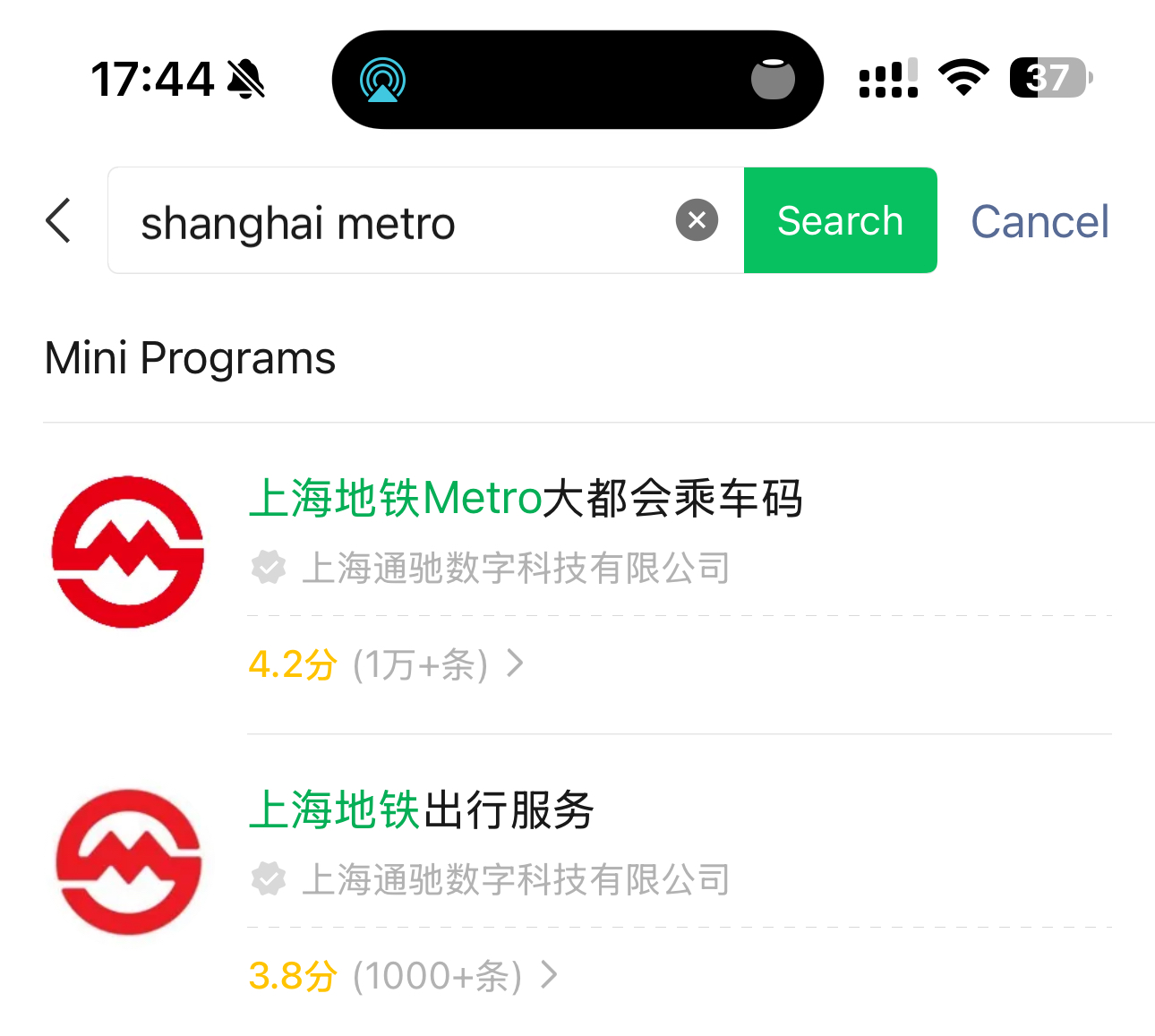
Then click on the first result and you’ll see the Shanghai Metro app:
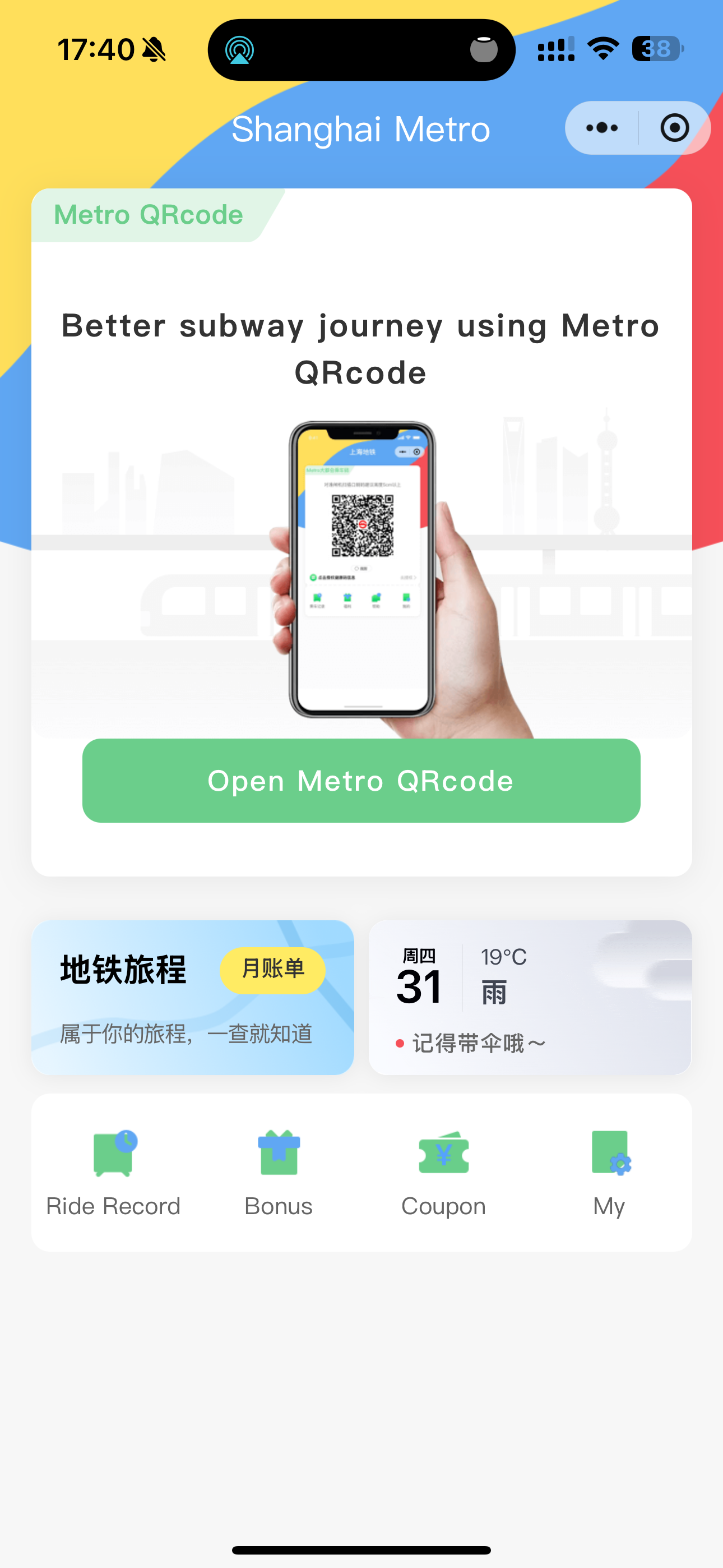
From here it’s (almost) all in English. You will need to have set up a way to pay using WeChat pay, which brings us to our next topic below:
App-Based Payment
To say that China has embraced electronic and app-based payments is an understatement. The only times I have handled cash in the last two or three years has been to give gifts to people (a red envelope full of cash is a very popular gift in China). You will need some way to make electronic payments using either WeChat or Alipay.
Since 2023 both apps have made reasonable efforts to work with non-Chinese bank and credit cards. That said, some folks seem to have issues with one or the other so if your card does not work with one app, try the other one.
There are some steep fees for transactions over 200 RMB (3%) which do add up. Also, the first time you use the payment in either app there are often extra steps, bank verifications, et cetera, so be sure to test the functionality when you arrive to China with a small purchase.
Ctrip

If you’re going to do any traveling around Chinese cities, the Trip app is (in my opinion) indispensable. Where it really shines is booking train tickets, which used to be real pain but now can be done on the app up until about 30 minutes before departure. Flight booking (for Chinese Airlines anyway) on the app is also smooth, much better than trying to book Chinese airlines from other sites like Expedia.
You can set up your profile, including your passport, as well as the names and passport numbers of anyone traveling with you. Then when you book a train ticket, you just scan your passport to enter the gate. Important note: In a lot of train stations, you will need to use the “manual lane” to scan your passport as the regular gates can only scan Chinese ID cards.
If you (like me) are blessed with a long European name, beyond 27 characters, you will notice the app does not accept this. Chinese train and air booking systems cannot handle anything beyond that amount of characters. My advice is to simply delete characters from your middle name. For the trains, they only care about the passport number. Airlines care sometimes, if so they’ll just write the rest of your name on the ticket in pen.
Payment on the trip app can be done with any overseas credit card or Apple Pay.
There is an official train app, 12306, which some of my friends swear is better than trip, but it’s just never worked well for me. YMMV.
Didi

What did we do before this app arrived? I almost forgot the hell that was standing on a street in Shanghai in the rain trying in vain to flag down the one empty taxi out of hundreds screaming down the road.
Uber gave China a shot a decade ago, and ended up selling out to a local competitor, Didi. You’ll find today the Didi app is about the same as any other ride-hailing app out there. The English search function is very mature as well, at least in larger cities.

Cash:
Unless you have a special need, you are not likely to need much cash, if any. There are plenty of ATMs everywhere in China, and almost any overseas card will work in any of them.
Phone Service:
If you are going to bring your mobile phone to China, you will get much better calling and data rates from your provider if you call first and set up a package of service. For example, for $5.00 per month of usage, AT&T will cut your calling rates in China by 50%. Most providers allow you to turn your international options on and off by logging in to your online account, but it may be simpler to give them a call and ask about the best options for China. Links for international pages of major providers are below.
One very important note: If you do not have an international data plan, you should turn off your data roaming in your phone, as these charges can add up to hundreds of dollars per day. Instructions for doing so in iPhone and Android are linked below:
Turn off data roaming in iPhone
Turn off data roaming in Android
Wifi is just about everywhere, so you should not need much, if any data for your phone. For GPS usage in China, you’re best to download google maps for offline use for the areas where you will be traveling as regardless of your data plan, GPS uses a large amount of data.
Medicine:
China has facilities for healthcare available in major cities, along with pharmacies that carry most prescription medicines. However, If you have medicine that you take for a specific condition, I highly recommend that you bring enough to cover your trip plus at least one week of extra doses. Similarly, if you take over-the-counter medicine for any purpose, bring sufficient amounts to cover your trip plus extra time. The air quality in China can change quickly; those with Asthma or similar respiratory conditions should bring both regular medicine as well as rescue inhalers. Note that US medical insurance policies are not accepted overseas unless you have added such coverage; be sure to check coverage before you go. Your company may offer coverage through business insurance; be sure to check and verify, and have the insurance info with you. You will want the policy number, confirmation of coverage, and the phone number or website to use to find hospitals near your location. I have had to do this a few times and believe me, the back of an ambulance is not the place where you want to be calling your HR department in the middle of the night to find this information.
Weather:
The weather in Shanghai can be above 90 degrees in the summer and down in the 30s to 40s in the winter. Winter is cold and rainy (like San Francisco in February); Summer is hot and humid (like Miami in August). Be sure to check the weather reports before you depart. Summer in Hong Kong is, for the uninitiated, often the most hot, humid place on earth; bring extra clothes, and breathable ones at that.
Hong Kong Weather (also covers Guangdong/Shenzhen though Shenzhen gets hotter and more humid)
Water:
Do not drink tap water anywhere in China. It is ok to be exposed to it in the shower, but otherwise you should limit consumption to bottled water. Hotels normally provide 1-2 bottles of water per day per person, you can always get more on demand and more often than not it’s free.
Food:
Food in China is, despite what you hear on the news, generally safe. If you have dietary restrictions you are well advised to make those known prior to embarking on your travels. It’s not unheard of for supposedly vegetarian dishes to be seasoned with pork powder or similar (and odd) condiments. Vegetarians will get far more traction and understanding by explaining that they are buddhists.
Street food smells great, and tastes great too, but for those just starting out in China, be careful; food poisoning is not uncommon especially in some of the smaller food stalls in smaller cities. If in doubt, pass!
Hygiene:
Communication:
Outside of major cities, English is not widely spoken. Two must haves: Print a paper with with phrases and words that you will need (addresses where you will be going, industry specific terms, etc) and bring a good dictionary on your phone or tablet that can be accessed offline.
Dictionary
By far and away the best electronic dictionary on the market is Pleco, available for iOS and Android. The free dictionaries are great, and you can add on additional features as needed. The character recognition is great for times when only characters are present, most notably on contracts and menus.
A close second are the google translate mobile apps for iOS and Android, I recommend downloading the complete dictionary for offline use, just in case. Also the google lens translation is getting fantastic.
Some handy phrases (print these out, if you find them useful):
我要去浦东机场
高铁战
How much (cost) – 多少(钱)
Slow down (driving) – 啊!开车慢一点!
Computer – 电脑

 Michael Diliberto
Comments are closed.