

Commercial Open Source Panel
It’s that time of the year again, time to vote on the proposed panels for the 2010 South By Southwest Conference. This year I have proposed a panel to briefly discussion the concept of Commercial Open Source, a model being followed not just from within the software industry (although software is our focus) but from many innovators in a diverse array of fields.

Winding Down at Thunderbird
It is really hard to believe that 19 months have gone by so fast, yet at the same time, I know that it is time to be done. I am back on campus for the last week of class, and all things going well, my MBA will be conferred this coming Friday.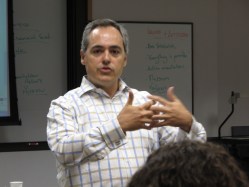
My classmates and I are participating on our capstone courses, receiving debriefings on a lot of the projects that we have been exposed to over the past few years. It’s been hard work, and this has been a long time coming. At the same time, I am sad to see it come to an end, and I will miss the classes and classmates that have come to occupy all of my formerly free time.
They asked us to stand up and say what our most important take-away from this program has been, and it was very hard to narrow it down to one single thing that stands above all others. For me, my greatest take away has been understanding that the most important responsibility that I have as a manager is not having all of the answers, but rather, knowing how to ask the right questions. One of the litmus tests that I revisit frequently is to look at past situations and ask myself if I would act differently in that same situation; in many cases, the answer is yes. Of course, I don’t know whether the outcome would have been different, but at the very least, I know that my increased knowledge helped me have a deeper breadth of understanding of all of the factors in play.
In other news, my session at South By Southwest has made it into the panelpicker, and is up for vote this week. I will be talking about the emergence of “Commercial Open Source” as a business model. Although at first, I had aimed this session at firms in the software space, my research in this topic over the past few weeks has led me to the realization that it is not just software but many industries that can drive innovation from the bottom up.
My cameo appearance on Google
I always figured it would happen someday…I was captured by a Google streetview car. One thing I can say, is that these vehicles are not discreet; I realized what it was immediately as soon as it pulled in front of me, and despite my best efforts to make funny faces and otherwise act like an idiot in view of the streetview camera, the only decent photo doesn’t even show my face.

My Interview with Bub.blicio.us
While at the Web 2.0 Expo I took some time to give Bubblicious Reporter Jolie O’Dell a brief overview of our newest release, MindTouch 2009.
Vodpod videos no longer available.
You’re Missing the Point

In the 16th Century, Niccolo Machiavelli famously wrote his discourse on the challenges faced by innovators:
“It must be considered that there is nothing more difficult to carry out, nor more doubtful of success, nor more dangerous to handle, than to initiate a new order of things. For the reformer has enemies in all those who profit by the old order, and only lukewarm defenders in all those who would profit by the new order…”
This weekend I will be attending Transparency Camp in Washington DC, and as I prepare for my presentations, I can’t help but notice that a lot of the talk of “Government 2.0” misses the point when speaking about the value of the tools being used. I’ve read hour long presentations on why twitter is awesome for government (it is awesome, I get it, but that is beside the point) and I’ve seen far-too-long powerpoints on how to broadcast using these new tools. STOP!
You’re missing the point!
The value of these new tools is that these new tools step out of the way, cut the static and let us get to the data; that is, the data is fast becoming disintermediated from the source. For years, data has been available in silos from many government organizations; data, in these silos, has very little value. The true value of data comes not from collecting it, but analyzing it to create intelligence. The true value of these new tools, like twitter, is that you do not need to use twitter.com to access twitter’s data; twitter, through their API, gives anyone access to anything said by any one of their members.
There is value in being the hub at the center of millions of conversations
If you watch all of the data go by, you can grab the bits that you care about to create the whole picture; mash twitter feeds together with the oscars or american idol and you start to get a good picture of who is paying attention and what they are thinking. The value of these tools is that now we can create that same type of intelligence around government applications. Government data has always been (for the most part) a matter of public record. The emergence of APIs connected to this data means that now we can mash up congressional voting records together with lobbyist donations. What will we see? How will this change things? It has been said that the barrier to entry for true participatory democracy is an inability for the populous to possess adequate knowledge necessary to make informed decisions. Watch closely; the sun is setting on that world.
People of the world, prepare to be educated!
The intelligence created out of these easy to access data sources is going to be the catalyst for the next great shift in governance. Many government agencies are going to resist, and the most frustrating factor that they are going to find is that the people are able to go on whether government agencies are involved or not. API’s and data access have created a reformer that is billions of people strong. Those in the ivory towers can resist, but clearly, they are outnumbered.
So what is the point? What is the value of these tools? The point is, these new tools, APIs for every data set, are going to put knowledge in the hands of the many. And at the end of the day, the many have the power of the vote, they decide your fate. If everyone in America watches your voting record flex in tandem with your lobbyist donations, well, I would wager a bet that you won’t last long in this new order of things.
Do You Hate Sleeping Too?
 As some of you already know, for the past year I have being working on my MBA mostly nights and weekends, which basically means that I’ve traded all semblance of a social life in exchange for a degree.
But it is so much more than that. Last night I finished this semester’s coursework and now I have a month off to reflect (and land a job!) before we start back up again.
It’s been an amazing experience so far; I can not even begin to describe how much I’ve learned in the past year. I often find myself reflecting on situations and decisions which I made in the past, and how I would have approached them differently given what I know now.
Like many technical professionals, I started my career on the technical side. I landed a job with a Fortune 500 firm right out of university, and only then did I begin my exposure to the business side of the world. Far too often technical people get caught in the trap of being technical for the sake of the technology, instead of using technology as needed to solve genuine business issues. I learned fairly quickly the need to have a business case for innovation, and much to my surprise I was able to play the game pretty well in the political environment that exists in any firm of significant size.
In 2003 I (along with 4,000 others) was “downsized” and ended up at a small startup. Now for those of you who have worked in a corporation of any significant size, you know that a corporate environment often has clear lines of demarcation; there are processes and proceedures for just about anything and departments to go to for travel, expenses, and HR. In a startup environment, it is the exact opposite. At the startup office, we had poster on the wall with the favorite phrase of our founder “Just Get It Done, Mate!” I was, for a long time, the sole US-based employee (it was an overseas startup). Somehow, calling it trial by fire doesn’t even do it justice. In the 4 years I spent there, I learned more about business than I had learned in 4 years of undergrad (ok, ok, 5 years of undergrad) and 3 years of corporate life.
I discovered two things during my 4 years in that startup environement; First, I discovered that I can, in fact, work 12 hours a day, every day. Secondly, I found that as much as I was learning, I needed more formal business education to become a truely well rounded professional. Someone once told me that I had great business instincts, but I needed more credentials to back up the decisions that I was making.
So, after scaling back my hours at work to only 8 hour days, I dedicated a solid 4 hours per night, on most nights, to pursuing my MBA. It has not been easy, but I can say, beyond a doubt, that it has been the best educational experience I have undergone thus far. It’s not for everyone, but for me it is the missing piece that I needed. The irony is, during undergrad, I did not take school nearly as seriously as I do now. All I ever wanted to do was be social and travel; the actual education part was never that high on the list. Now, suddenly, I am in an environment with people just like myself and I find myself competing to be better, actually caring about my grades and further, actually wanting to learn even more than the material being taught in class.
So if you can work another 4 hours after you’re done with a standard work day, if you find yourself wanting to know more about the area of business you find yourself in, and if, like many professionals, you find that you work better when the pressure is on, well, you might want to look at getting your MBA too.
I wish I could find the original source of the photo above, but it came to me in an email. If this is your photo, shoot me a message and I’ll give you credit.
Circuit City
By now just about every news outlet and blogger has penned an article debunking the press release from Circuit City citing “decreased consumer spending” and “unfavorable economy”. After all, it is hard to believe that the economy pummeled Circuit City while sparing Best Buy.
Over the course of the past few days, I’ve read a multitude of articles citing poor real estate selection, exit from the appliance business, placing too much importance on flat panel TV margins, and the like as the “true reasons” for their demise. I think it is far more simple, and far more sinister. Circuit City lost the game because they failed to tap their most powerful resource: their people. They didn’t listen. They didn’t engage their employees or their customers. Circuit city has tens of thousands of employees in their stores and many of these employees are within the lucrative target demographics and value propositions which Circuit City was chasing. Yet time and again, Circuit City failed to engage these associates to help them drive innovation from the store level upward. Decisions were all made “at corporate”, giving employees very little ownership of the company. This type of quasi-military structure worked half a century ago when Circuit City started, but it has no place in the modern workplace.
There was an important lesson that should have been taken away from the DIVX experiment which Circuit City undertook in the late 90s, and that lesson is, now that people can communicate easily over the Internet, the backlash from a determined community of users can affect your business very negatively. Here, the most powerful consumer electronics company in the world (at the time) lost over 100 Million dollars, mostly attributable to the vigilance of a few Internet home theater forums. The lesson here is, no matter how much money you spend, or how you try to spin the story, it is your customers that will define you. Your only choice now is whether you want to be a part of the conversation or not.
Customer driven innovation is the embodiment of this stream of thought; the way to be successful with your customers is to listen to them and let their demands mold who you become as a company. Just as a determined group of internet users can harm you, a group of customer evangelists can build your brand from the outside in. Some retailers have caught on; they let store associates and managers make decisions to help their stores address local market demand; they drive change in the reverse of their supply chain, from the bottom up; even Walmart does this to a certain degree. The dawn of the social media era has been embraced by these same retailers. These days, it is not uncommon for customers to exchange Twitter messages with C-level executives, or interact with them on their blogs. Circuit City’s blog and twitter account amounted to little more than thinly veiled marketing efforts.
On March 28th 2007, Circuit City famously sacked their 3,400 most experienced, most passionate, and most highly paid workers. Both outside and inside the company the message was clear: “we do not value our associates very highly”. Internally, another subtle vibe was likely felt, which was “don’t rise to high, or be paid too well, or you’ll get the ax as well”. Neither one is conducive to employees working hard or trying to get ahead; any undergrad business major can tell you, the way to motivate your employees is to give them the impression (real or otherwise) that their hard work will be rewarded with higher pay and promotions. So if we break for a quick logic lesson:
If [Work Hard] implies [Higher Salary]
And
If [Higher Salary] implies [You Will Be Fired]
Then
[Work Hard] implies [You Will Be Fired]
And that, dear friends, is why most Circuit City employees were paid $8.00 per hour to play solitaire.
The DIVX lesson really should have come up as the board considered the plan to sack these workers. Someone should have stood up and said, “but the people will lash out at us for this, and you all remember what happened last time, with that DIVX thing, right gentlemen?” But nobody stood up; everyone believed, naively so, that customers and employees would just stand there and take it. Wrong. In true freakanomics style, Circuit City misjudged the environment they were in, and once again, made a strategic misstep which saved 3.5 million dollars in the short term in exchange for bankrupting the company in the long term.
So what does this all boil down to? The same thing my father gets in trouble for all the time: Not listening. Circuit City failed to listen to their associates, they failed to listen to their customers and they ignored their critics. They failed to embrace change. Even before social media was “cool”, Circuit City failed to listen to their employees, they failed to engage their customers in meaningful dialog. They led from the top, while ignoring the bottom. They neglected to engagee their customers in dialog. They foolishly thought that just because they were once a case study in “Good to Great”, they were imune to failure. When business textbook authors write their chapter on the danger of organizational silos, I think Circuit City would make a great case study.

 Michael Diliberto